


Why Text-Based Adult Chat Is Still Popular in the Age of Video and AI
Online adult communication has moved through several distinct phases. Early chat rooms and bulletin boards in the 1990s relied entirely on typed words because bandwidth couldn’t carry much else. Webcam platforms followed as connections improved, and more recently AI companions have appeared, offering conversation with software instead of a person. Each format arrived with predictions that it would replace the one before it.
That replacement has not happened. Text has outlasted each new format because it asks something different of the user than a video stream does. Researchers who study online communication have a name for part of this effect. In his 1996 study “Computer-Mediated Communication: Impersonal, Interpersonal, and Hyperpersonal Interaction,” published in Communication Research, Joseph Walther argued that text-only exchanges can feel unusually close, since people choose their words carefully and fill gaps with their own idealized impressions. That helps explain why a plain typed conversation can feel more involved than its simple format suggests.
How Typed Conversation Became Its Own Format
A visual medium delivers a finished image: the viewer receives appearance, voice, and setting all at once. Many people who seek out online sex chat choose it because text delivers only language, so the reader supplies everything else. Neither approach is better in general, but they produce different experiences, and the written format has adapted over the decades instead of disappearing.
Text also has practical advantages that have little to do with taste. It works on a slow connection, in a quiet room, on a shared commute, or late at night without disturbing anyone. It can be paused and resumed hours later without losing its place, which a live video session cannot do.
Why Imagination Matters in Text-Based Intimacy
Reading and writing ask the brain to build a scene from nothing. When a partner describes a setting or an action in a sentence, the other person pictures it in their own terms, which makes the result personal in a way a fixed image cannot be. Walther’s study points to a related process: with fewer visual cues, people tend to project qualities onto the person they are talking to, and the typed pauses between messages add anticipation.
Verbal skill also becomes the main way of showing interest. A well-timed phrase, a teasing tone, or a slow build across several messages carries the emotional weight that facial expression would carry on camera. Dirty talk is a clear example, since the entire exchange depends on word choice, rhythm, and what is left unsaid.
Anticipation builds further when the conversation is allowed to unfold slowly. A single suggestive line can carry a whole evening’s worth of tension, and a dirty talk chat shows how much a few well-chosen words can do without any image attached.
The Appeal of Personalized Roleplay
Typed roleplay lets two adults invent a scenario together and steer it as it unfolds. A participant can set the characters, the setting, and the pace, then change direction by editing a single line. This shared authorship has much in common with collaborative fiction and tabletop role-playing games, where the story belongs to everyone at the table.
Boundaries are easier to state in writing, too. Limits can be set before a scene starts and restated mid-scene without breaking the mood. That active, co-creative quality separates it from passive viewing, where the audience consumes what someone else produced.
Customization also extends to tone and genre. One scene might be lighthearted and playful, while another borrows from mystery, fantasy, or workplace drama. Anyone curious about how this works in practice can look at how a roleplay sex chat is structured around characters and settings chosen by the participants.
Text Chat vs. Video Chat vs. AI Companions
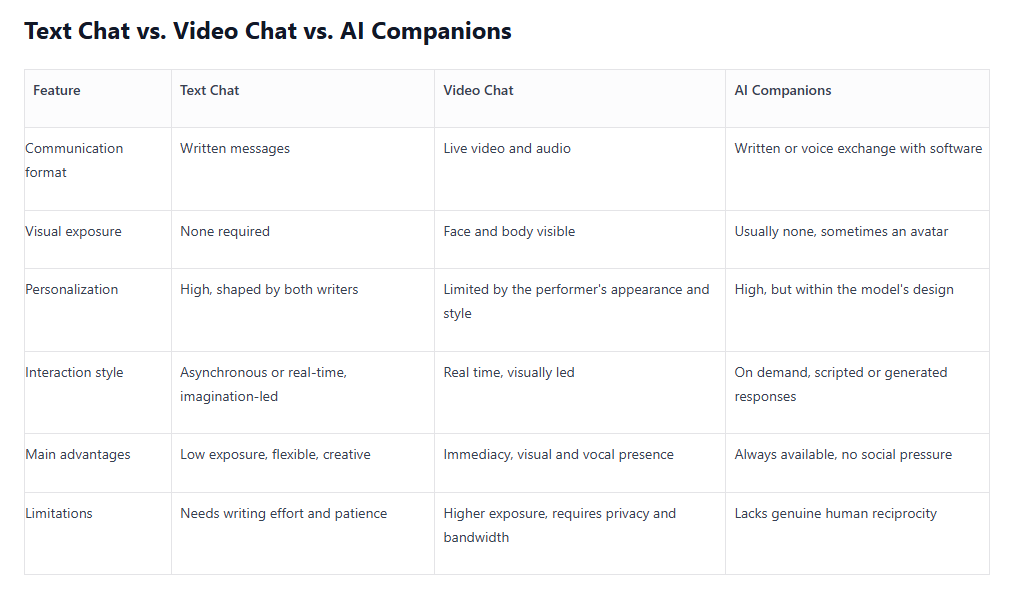
Each format fits a different mood or circumstance, and many users move between them.
Privacy and Anonymity in Adult Chat
A webcam records a face, a room, and sometimes identifying details. Text does not. Many adults prefer it for that reason alone, because a username and a typed conversation reveal far less than a video feed. Choosing a pseudonym, avoiding real names, workplaces, and locations, and deciding in advance what stays private are simple habits that keep control with the user.
Platform choice matters just as much. Readers should look for clear privacy policies, stated rules on data retention, and an explanation of whether conversations are stored or moderated. Those who value discretion often turn to anonymous sex chat for exactly this reason, and any such service should be open about these practices. For clarity, XtremeChat describes online-only fantasy interactions with professional chat partners, which may involve human moderation or AI.
Where Text, Video, and AI Go From Here
The more likely outcome is coexistence. Video will keep serving people who want visual presence, and AI will keep improving for those who want constant availability. Text will probably remain the format where users supply the imagery and shape the story themselves. As long as people value control over how much they reveal and enjoy building a scene from words, typed conversation will hold a stable place beside its newer rivals.
